






Gothic is a lifestyle. You hear that again and again from the scene members in interviews. But what does it actually mean? Do you have to go shopping dressed as a vampire, paint your walls black and sleep in a coffin to be "in"? Of course not.
What is meant by this statement is rather that goths do not dress up for a festival or a party. Their scene affiliation also plays a role in everyday life. Most goths naturally adapt their outfits to the daily demands, because the black scene has long ceased to be a youth culture. You have to work, you have a family and obligations. And if the employer doesn't allow a too dark outfit, jewellery or style of dress, then you just have to dress up. The undercut is covered, the piercing is taken out, the black clothing is defused with colourful accessories so that no customer or colleague in the company is frightened. And that is exactly the point.
Gothics tend to dress up in everyday life rather than in their leisure time, while the often criticised "weekend goths" dress up in a black carnival costume for the party or for a festival at the weekend and prefer mainstream fashion in everyday life. The homes of goths also betray their dark attitude with many small and large accessories. They don't even have to sleep in a coffin for that. Jewellery, hair, make-up, accessories, home furnishings and even dance style betray the subculture. Whether the goth likes it or not.
You can't shed your passion for the dark with your clothes, so it always flashes through. As a goth, you stand out, even if you make an effort to fit in at short notice so that everyday life succeeds. The subculture always shows through. And this is roughly how it looks when you let it run free:
Clothing
There is no uniform style of dress in the gothic scene. The individual sub-scenes are simply too different for that. Nevertheless, some fabrics, shoes, garments and features can be described as typical for the scene. The colour black still dominates the wardrobe, of course.
Characteristic of the scene is the blurring of the genders, which has nothing to do with a sexual orientation. Men definitely also wear dresses, skirts, heels and make-up. There are no gender-specific dress norms, even if some sub-scenes like the EBMers and the metal faction are dressed more according to the classic role model than others.
Sexual preferences or sexual identity, however, have nothing to do with the gender confusion of the goths. It's about playfulness, statements and styling, as David Bowie, for example, exemplified with his art figure Ziggy Stardust.
Gothic, Fetish, Dracula - Typical Outfits in the Gothic Scene
But where one scene ends and the other begins is sometimes hard to tell. While the goths and wavers of the early days of the scene still showed a lot of clothes and little skin, today it is often the other way round. Bondage trousers, corsages, little fabric, lacquer, leather and the studded collars from the punk era then result in an image that you would also find in the S/M scene or in the fetish scene in a similar way, especially since the colour black is predominant there too. Some goths like it, others don't.
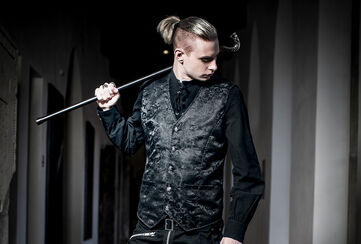
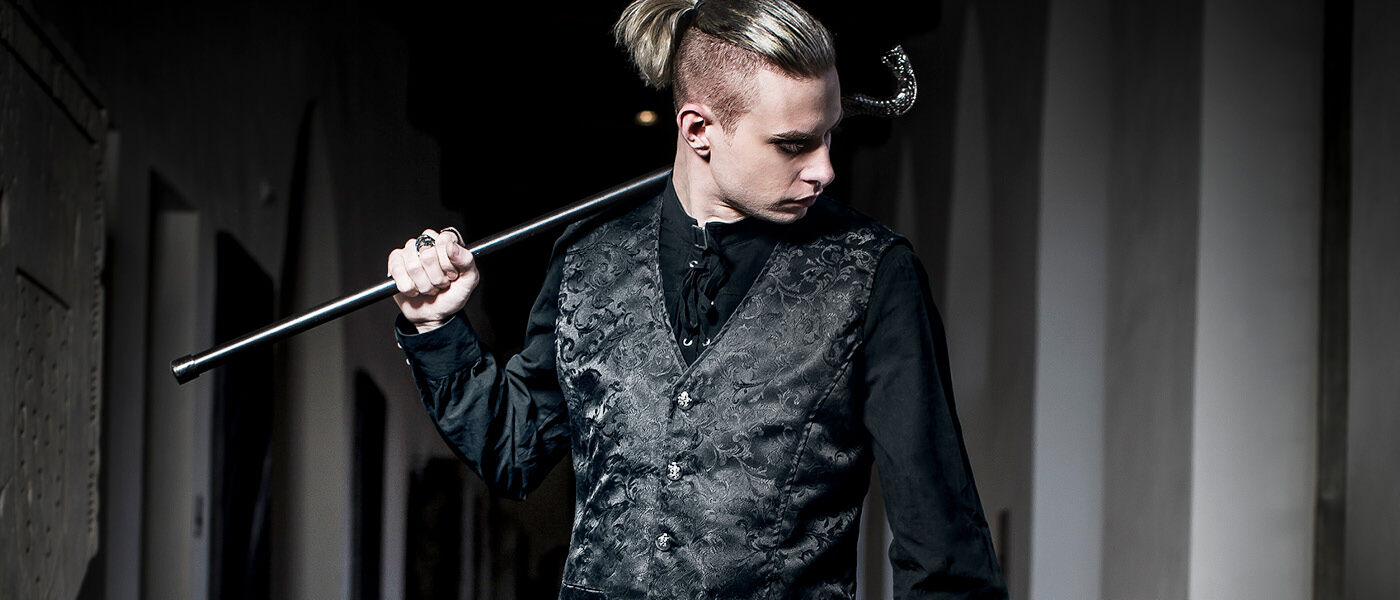
Gothics love dresses and tops made of panne velvet. Trousers, frock coats, waistcoats and coats can be made of brocade or silk. This not only looks Victorian, but also decidedly vampiresque. Lestat and Louis from "Interview with a Vampire" send their regards. Add a frilly shirt, walking stick, sunglasses and top hat and Bram Stoker's Dracula is perfect. Unlike the film, however, goths prefer a much darker make-up and men rarely wear beards. Dresses, cloaks and capes also tend to be inspired by romantic vampire films in terms of cut and fabric. Nevertheless, the goth is not a cosplayer, but merely draws inspiration for his gloomy style.
Less romantic representatives prefer leather coat, leather trousers and mesh top. In combination with dark make-up, silver jewellery, gothic belt buckles and boots or spikes, outfits are created that are reminiscent of films like The Crow or Underworld. Here, too, the focus is on inspiration, not imitation.
The no-nonsense, simple faction of the waver tends to wear fabric: harem pants, blazers and straight shirts with or without patterns. A must here are the pikes, or winklepickers. These are pointed, flat shoes with buckles and thin soles. They are now hard to come by. If you own an original from the 80s, you can consider yourself lucky.
Fishnet shirts, off-the-shoulder tops, tight trousers and Doc Martens or boots. For some goths, their punk origins can still be seen in the outfit. As an alternative to the fishnet shirt, people also like to play with tights. They are simply converted into a top. To do this, a hole is torn in the "crotch" for the head, the foot parts are cut off so that the hands can find an exit, and with a few holes and running stitches, the punk-goth top is ready for action. For the batcavers, who often wear platform boots, the tights even make it over the boots - and usually in white and torn out to resemble a spider web.
Anything can, nothing must
Since the beginning of the black scene in post-punk, the wardrobe of goths has been well filled. There are hardly any who stick strictly to the classic models here. There is a wild mix and everyone puts together their own style from the possibilities or even invents a new one. The "style" can also consist of a plain black T-shirt and plain black jeans. By far the largest part of the scene does without elaborate outfits that photographers like to chase at festivals because they supposedly represent the scene. Belonging to the scene is also expressed through clothing, but the love of music and the affinity to the dark are more important criteria. That's why it doesn't work to put on "something black" without a passion for the content in order to become part of it.
Jewellery
Jewellery is simply part of it - as a statement or simply to underline the outfit. Chains, rings, earrings, piercings: at first glance, none of this is different from the mainstream. But at second glance you discover typical symbols and creepy details that you don't see every day. At least not if you are not a goth.
Typical symbols in the scene include upside-down crosses, pentagrams, ankh signs, bats, ravens and many more motifs that spring from mysticism, religion or fantasy. Real bones, real claws, gemstones, rivets and leather are also popular. Gruftis mainly wear silver jewellery. In recent years, however, there have also been tendencies towards gold.
A very typical piece of jewellery that is almost non-existent in the mainstream is the nose chain. It is attached to the earring and the nose ring and hangs over the side of the cheek. It is decorated with pearls, crosses, ankhs or other gothic symbols. The claw ring is almost as rare in the mainstream. It is pulled over the finger and replicates a long claw made of silver.
Body modifications are playing an increasingly important role in the black scene, even if they are more common among younger generations. Split tongues, incisors sharpened into vampire teeth or sharpened ears reminiscent of elves: The difference to the costume is clear. Teeth or ears are not "disguised" but surgically modified - and that is difficult to hide in everyday life.
The headdress also distinguishes goths from the mainstream. In recent years, so-called gohic headpieces have become popular. These are elaborately designed, handmade structures made of feathers, hats, horns, natural materials, gemstones, veils and many more details. There are no limits to the imagination and the artisans of the scene outdo each other in the design of the magnificent headdresses, which predominantly match the romantic outfit. Even the New Romantics in the 80s relied on eye-catching headdresses with hats, scarves and veils.
A simpler, but even more important jewellery is the sunglasses. They should never be missing. Actually, it doesn't even matter if the sun is shining. Brightness is reason enough! Most goths wear simple sunglasses, but there are now also suppliers who offer glasses in the shape of bats or coffins. Steampunks are also constantly coming up with new designs that are reminiscent of aviator glasses, for example.
What the mainstream knows at best from carnivals is part of the normal outfit in the gothic scene: contact lenses in all mystical colours and shapes round off the gloomy overall image. Artificial eyelashes add the finishing touch to the bold make-up.
Tattoos are not necessarily typical of the scene. However, as they are becoming more popular in society in general, you also see tattoos in the scene. Here it is the motifs that can differ from the mainstream. Gothic sayings, bats, gothic symbols, scenes from films, skulls. Of course, the black scene does not have the latter to itself.
The same applies to jewellery: everything is possible, nothing is compulsory! In general, you can say that goths wear a lot of jewellery. Lots of rings, lots of necklaces, lots of piercings, lots of bangles, lots of earrings: possibly this, too, has arisen from an exaggeration of the rather discreet mainstream. Anyone who looks at pictures of Madonna in the 80s, for example, knows that mountains of jewellery around the neck and on the arms are not an invention of modern times.
Hair
When it comes to hairstyles, the black scene has always been very creative. It all started with a lot of hairspray and a toupee brush. Robert Smith demonstrated the fuzzy crow's nest on his head in the 80s and the fans copied him. In order for the wildly puffed hair to hold, a lot of hairspray was needed.
At the same time, punks were also the ancestors of goths and so sidecuts were shaved to make the hair into a mohawk, or undercuts. Other special hair creations in the 80s were the plate and the tower. With the tower, the hair was pasted upwards to form a straight tower, and with the plate, the hair formed a flat surface when viewed from above. Hair creping was also very popular - a trend of the 80s that prepared the hair well for toupeeing. The hairstyle simply held better afterwards.
Over the years, you saw fewer and fewer towers and plates in the scene. Today, they hardly exist anymore. The mohawk, however, has endured, evolving into the deathhawk. Black instead of colourful is the motto here, although dark colours or grey tips can also be seen on the Deathhawk. Those who are surprised about the tips that some goths leave standing in front of their ears: In everyday life, the sidecut can be better hidden with these strands. As a result, the "tipples" (birdie) eventually became an integral part of gothic hairstyles. But they are not a must.
With the various gothic trends and the new possibilities offered by the internet, new hair trends entered the scene, for example the gothic dreadlocks, which were usually attached to the hair in black, white, purple, blue or green. Hairpieces were also much easier to get in the course of online trade and made their way into the black scene. With the Asian influences from the manga and cosplay scene, people were also wearing more and more wigs in eye-catching colours and cuts.
Speaking of eye-catching cuts: The fringe in some gothic hairstyles is cut outlandishly - very short and straight, or tapered and gaudily coloured. But the typical gothic hairstyle no longer exists. At Gothic festivals you see many sidecuts, many undercuts and very different creative hair ideas. The hair is the most important thing! That's what they say in the scene - on the quiet.
Make-up
Hair alone does not make a goth. The make-up has to be right too! However, it should be said in advance that it is not a criterion for exclusion if you don't wear make-up. But it can be if you put on the wrong make-up. If you want a healthy tan on your face, you're already completely wrong. Lime-white colours are the order of the day. Take the make-up one or two shades too light rather than too dark.
Many goths even resort to theatrical make-up and "lime" their skin. If you leave out the ears, neck or hands, you expose yourself as a beginner. Experienced "whitewashers" wear gloves to whiten their faces. The whiteness, by the way, is not an expression of a preferred skin pigmentation or nobility, but a tribute to death. And besides, it is exactly the opposite of what the mainstream likes.
This is then how the black lipstick is to be understood, putting an end to the healthy red of the lips. Black kohl and black eye shadow then draw the eyes into dark caves. Of course, this is only a generalisation of typical gothic make-up. On YouTube there are countless gothic make-up tutorials that prove that you need some skills to wrap yourself in a gloomy make-up that doesn't look like a carnival in kindergarten. Artists of the scene such as Siouxsie Sioux or characters from vampire and horror films serve as models here. Each make-up is also given a personal touch, there are no standards.
Typical for a gothic make-up are the strict, vampiresque eyebrows, which can only be drawn if you completely shave off your eyebrows and repaint them.
With heavy eye make-up, one's own eyelashes look quite unimpressive. That's why many goths wear artificial eyelashes that are stronger and longer. Individuality and creativity are then called for in the make-up details: ornaments, gemstones, eyeliner, contours. The main thing is that the make-up doesn't look summery and cheerful! However, it should also be revealed that the majority of the black scene simply leaves it at black kohl.
Accessories
A plain black outfit can be transformed to suit the scene with the right accessories: Buttons on the blazer, patches and studs on the jacket, chains on the belt or boot. However, it is important that the buttons and patches are authentic. Unlike mainstream fashion, the gothic outfit is a statement. You don't just wear a band shirt here if you neither know nor like the band. The button and patch outfit goes well with the classic studded collar known from the punks.
For the romantic outfit, goths like to choose masks, fans, top hats, walking sticks and lace gloves. The fanciful and fairytale outfits are accentuated with headpieces and horns. Chokers, which leave space in the middle for a gemstone or a decorative motif, are also very popular. Numerous artisans of the black scene go to great lengths to implement new ideas in handicrafts time and again. These accessories are offered for sale at Gothic markets at festivals or events. Particularly individual pieces are created when you do it yourself. "Do it yourself" has always been en vogue in the scene.
A big playground for gothic designs is also the handbag and shoulder bag section. Here, there are all kinds of possible and impossible designs with skulls, bats or references to Gothic literature, mysticism and magic. The same goes for wallets and mobile phone cases. The classic Gothic bags include the black BW combat bag decorated with buttons and writings.
Living style
Whoever visits a goth is sure to spot skulls, candlesticks or bats somewhere. The dark attitude may also show up on the bookshelf, but certainly in the music playing. Whenever possible, goths choose black interiors. The crockery, bedding, pillowcases or towels also betray the preference for dark.
However, goths painting their walls black and sleeping in a coffin is more of an exception than the rule. Black walls and ornamental wallpaper may set accents, but a completely black flat is probably hard to find. In the meantime, there are some alternative furniture designers who make cupboards or tables out of coffins or in the shape of coffins, or offer shelves and cupboards in the shape of pentagrams. These unique pieces are not cheap, however, and therefore not the norm in the Gothic household.
Very characteristic, on the other hand, are grave lights, which are placed instead of normal candles. Those who appreciate attention to detail also buy black everyday utensils. Black handkerchiefs, black napkins, black toothbrushes, black soap: the penchant for eerie ambience shows through everywhere. In most cases, you will also find posters of gothic bands, gothic festivals or gothic films. The age of the inhabitants is irrelevant. It is the style of living with all its small and large darkly aesthetic details that makes it clear that Goth is a lifestyle.
Dance style
On the dance floor you can immediately see who belongs to the black scene and who doesn't. You will hardly find any happy jumping and communal laughter here. No one raises their arms and claps or jumps to the beat. Goths are more introverted on the dance floor and let themselves be carried along by the music. The typical gravedigger dance from the 80s allowed three steps forward and three back - not dynamically hopping, but with drooping shoulders and lowered eyes. Today you see a few variations, but they all seem more introverted than extroverted. Even the EBMers, who have a faster and snappier dance style, dance facing inwards.
The beat doesn't always matter on the dance floor either. The movements often take place in slow motion. Gruftis accompany the music with slow arm movements, others dance on the spot. Restraint is the order of the day. Depending on the party, things can look different on the dance floor. The black romantics like to sweep the floor gracefully with their clothes, while the batcavers take up space with big steps. The rule is always: be considerate and only get closer to each other if you really know each other. There is no "dancing on" strangers or extroverted come-ons. And even if everyone on the dance floor knew the lyrics by heart, no one would sing along loudly, especially not in chorus with others.